
8-Day Shira Route: From Lemosho Rainforest to Uhuru Peak
- Information
- Tour Plan
- Location
- Gallery
- Reviews
- Additional Info
- Similar Tours
- Complete Guide & Expert Insights
What's included
- All camping equipment (tents, sleeping mats, dining tent, portable toilet)
- All meals on the mountain (breakfast, lunch, dinner)
- All park fees for Mount Kilimanjaro
- Fair wages for mountain crew (as per park regulations)
- Government taxes and VAT
- Rescue fees and safety equipment (oxygen cylinder, first aid kit, oxymeter)
- Sleeping bags
- Transfers between hotel and mountain gate
- International flights
- Optional activities not listed in itinerary
- Personal expenses (laundry, souvenirs, etc.)
- Personal trekking gear
- Pre- and post-climb accommodation (usually 2 nights)
- Services not specifically stated in the itinerary
- Tanzania Inbound Travel Insurance (US$44 per person, mandatory for visitors from 1 October 2026)
- Tips for guides, porters, and cook
- Travel insurance (must include high-altitude trekking)
- Visa fees for Tanzania

Rainforest Start on Kilimanjaro’s Western Slopes
Begin at Lemosho Gate in some of the most untouched rainforest on the mountain, home to black-and-white colobus, blue monkeys and forest birds. The gradual climb through forest and heath to the Shira Plateau gives your body time to adjust from the very first day.

Vast Shira Plateau Crossing with Panoramic Views
Traverse the expansive Shira Plateau, an ancient volcanic caldera offering sweeping vistas of Kibo Peak and endless moorland – one of the most photogenic sections of the best Kilimanjaro routes for acclimatization and solitude.

Lava Tower Climb for High-Altitude Acclimatization
Reach the dramatic Lava Tower at 4,630 meters for a crucial “climb high, sleep low” experience, boosting your summit success on the 8-day Shira Route.

Thrilling Barranco Wall Scramble Adventure
Conquer the famous Barranco Wall with non-technical scrambling and hands-on rock navigation, rewarded by stunning views of southern glaciers – a highlight for thrill-seekers on Tanzania’s top Kilimanjaro climbing route.
 Alpine Desert Traverse to Barafu High Camp
Hike through barren alpine desert landscapes dotted with giant groundsels, arriving at Barafu Camp with close-up summit previews – essential preparation for Uhuru Peak on the scenic Shira Route.

Midnight Summit Push to Uhuru Peak
Leave Barafu Camp around midnight and climb steadily by headlamp to Stella Point on the crater rim, arriving as the sun rises over Mawenzi. From there it’s a gentler walk past glaciers to Uhuru Peak (5,895 m), the highest point in Africa.

Rapid Descent Through Changing Ecosystems
After the summit, descend through alpine desert and moorland to Mweka Camp. On the final morning, walk down through lush rainforest to Mweka Gate, passing through nearly all of Kilimanjaro’s climate zones in a day and a half.

Year-Round Climbing with Seasonal Wonders
Climb the Shira Route year-round: clear, dry skies from June to October and January to February, or greener, quieter trails in the shoulder months of November and March.

Private, Locally-Guided Support from Arusha
Benefit from Tanzanian expert guides, porters, and fresh camp meals on this 8-day Shira Route climb – the most acclimatization-friendly option for summiting Kilimanjaro with The Woven Experience.
Shira Route Prices 2026 (per person)
Price per person (USD) · 8 days / 7 nights · Park fees, guides, porters & meals included
| Group size | 1 person | 2 people | 3 people | 4 people | 5 people | 6 people | 7+ people |
|---|---|---|---|---|---|---|---|
| Price per person | $2,983 | $2,378 | $2,179 | $2,109 | $2,085 | $2,030 | $2,000 |
| 7+ group: contact us for a custom quote. Larger groups may receive additional discounts. | |||||||
Ready to climb Kilimanjaro?
Secure your spot today — limited spaces available per departure date.
- Day 1
- Day 2
- Day 3
- Day 4
- Day 5
- Day 6
- Day 7
- Day 8
Londorossi Gate → Lemosho Gate (2,100m) → Mti Mkubwa Camp (2,650m)
Drive: about 3–4 hours from Arusha
Distance: 6–7 km
Hiking Time: 3–4 hours
Difficulty: Easy to Moderate
Habitat: Montane Rainforest
After breakfast, you’re collected from your Arusha hotel and driven around the western side of Kilimanjaro to Londorossi Gate. Here you register with the park authorities while your crew weighs and organizes the equipment. A short drive then brings you to the Lemosho trailhead, where your trek begins.
The trail winds gently uphill through some of the most untouched rainforest on the mountain. Towering trees are draped in moss, and black-and-white colobus and blue monkeys move through the canopy. Elephant and buffalo also live in this forest, so you may spot their tracks along the path.
You reach Mti Mkubwa (“Big Tree”) Camp in the afternoon, set in a forest clearing. Your crew has the tents up and hot drinks ready, and you fall asleep to the sounds of the forest.
Mti Mkubwa Camp (2,650m) → Shira 1 Camp (3,610m)
Distance: 8 km
Hiking Time: 5–6 hours
Difficulty: Moderate
Habitat: Rainforest to Heath & Moorland
Leaving the forest behind, the trail climbs steadily through giant heather and open heathland. As the trees thin out, the views open up across the western plains, and Kibo’s summit cone appears ahead for the first time.
After crossing the Shira Ridge, you descend gently onto the vast Shira Plateau, an ancient collapsed volcanic caldera. The landscape changes completely here: wide open moorland, volcanic boulders, and big skies.
You arrive at Shira 1 Camp in the afternoon. This is a big altitude gain in one day, so drink plenty of water, rest well, and tell your guide how you feel at the evening health check.
Shira 1 Camp (3,610m) → Shira 2 Camp (3,850m)
Distance: 6–8 km
Hiking Time: 3–4 hours
Difficulty: Easy to Moderate
Habitat: Moorland Plateau
Today is a gentle walk across the Shira Plateau that helps your body adjust to the altitude. The short distance and small height gain let you acclimatize while saving energy for the days ahead.
The terrain is wide and open, dotted with giant lobelias and senecios. On clear days, Kibo dominates the skyline. If the group is feeling strong, your guide may add a detour to the Shira Cathedral, a dramatic volcanic ridge with views across the plateau.
At Shira 2 Camp, an optional short acclimatization walk above camp helps your body adapt before you sleep.
Shira 2 Camp (3,850m) → Lava Tower (4,630m) → Barranco Camp (3,950m)
Distance: 10–11 km
Hiking Time: 6–7 hours
Difficulty: Moderate to Challenging (Altitude Exposure)
Habitat: Alpine Desert
This is the key acclimatization day. You climb steadily east across the alpine desert to Lava Tower, a 90-metre volcanic plug and your highest point before summit night, and stop there for lunch. In the afternoon, you descend into the Barranco Valley, past giant senecio trees, to sleep lower at Barranco Camp beneath the Barranco Wall.
Barranco Camp (3,950m) → Karanga Camp (4,035m)
Distance: 5–6 km
Hiking Time: 4–5 hours
Difficulty: Moderate to Challenging
Habitat: Alpine Desert
The day begins with the ascent of the Barranco Wall, a steep but non-technical scramble. Your guides show you every handhold, and reaching the top rewards you with sweeping views back across the valley.
You then traverse ridges and valleys beneath the southern glaciers before dropping into the Karanga Valley. A final short climb brings you to Karanga Camp, where you rest and prepare for the higher camps.
Karanga Camp (4,035m) → Barafu Camp (4,673m)
Distance: 4–5 km
Hiking Time: 3–4 hours
Difficulty: Moderate (Altitude Impact)
Habitat: Alpine Desert
A short day designed for rest before summit night. The terrain becomes increasingly barren, with sharp volcanic ridges and a stark, lunar landscape. The air is thin, and temperatures drop as you approach Barafu Camp, set on a rocky ridge.
After an early dinner, your guides give you a detailed summit briefing and check your gear. You go to bed early to rest before the midnight wake-up.
Barafu Camp (4,673m) → Uhuru Peak (5,895m) → Mweka Camp (3,100m)
Distance: 17–19 km
Hiking Time: 12–15 hours
Difficulty: Very Challenging (Summit Push)
Habitat: Arctic Zone to Rainforest
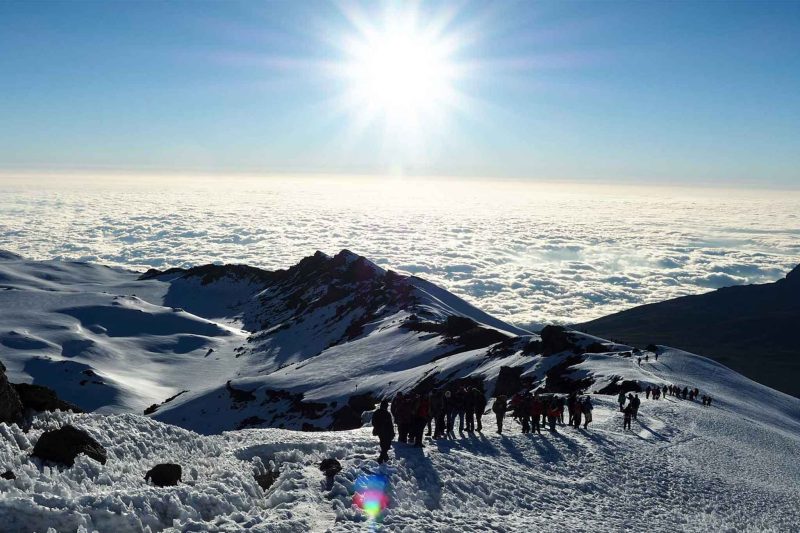
Your summit attempt begins around midnight. By headlamp, you climb slow, steady switchbacks up the scree toward Stella Point on the crater rim. This is the hardest part of the climb, physically and mentally.
You reach Stella Point (5,756 m) around sunrise, as the sky glows over Mawenzi and the plains far below. From there, it’s a gentler walk along the crater rim, past glaciers, to Uhuru Peak, the highest point in Africa.
After summit photos and celebrations, you descend to Barafu Camp for a rest and a meal, then continue down to Mweka Camp, where the thicker air makes sleep much easier.
Mweka Camp (3,100m) → Mweka Gate (1,640m)
Distance: 9–10 km
Hiking Time: 3–4 hours
Difficulty: Easy (Descent)
Habitat: Montane Rainforest
Your final descent leads through lush rainforest full of birdsong and towering trees. The trail can be steep and muddy in places, so take it carefully.
At Mweka Gate, you receive your summit certificate and celebrate with your mountain crew before the drive back to your hotel in Arusha (about 2 hours).
Meals: Breakfast
More about Kilimanjaro National Park Discover Kilimanjaro National Park
More about this tour
Location Overview
This scenic 8-day Shira Route climb ascends Mount Kilimanjaro, Africa’s highest peak and a freestanding volcanic massif rising dramatically from the Tanzanian plains.
Starting from Arusha (1,400 m / 4,600 ft elevation), the journey begins with a 3–4-hour drive to Londorossi Gate on Kilimanjaro’s western side, followed by a short drive to the Lemosho trailhead (2,100 m). From here, the route climbs on foot through remote rainforest and heath onto the expansive Shira Plateau, then crosses open moorland and alpine desert to the arctic summit zone. It is known for its wilderness feel, wide-open vistas and uninterrupted views of Kibo Peak.
Lemosho Forest & Shira Plateau (2,100–3,900 m)
The climb begins in the Lemosho rainforest and reaches the Shira Plateau on Day 2. This high-altitude landscape features rolling moorlands dotted with giant lobelias and senecios, offering sweeping panoramic views of Kibo Peak and the Shira Cathedral ridge.
Shira to Lava Tower (3,900–4,630 m)
As the route progresses eastward, the terrain gradually becomes more rugged and barren. The trail crosses high-altitude moorland into alpine desert, with increasing exposure to wind and thinner air. Lava Tower (4,630 m), a striking volcanic formation, serves as a critical acclimatization point where climbers “climb high, sleep low” to adapt to altitude.
Barranco Valley & Karanga (3,900–4,600 m)
Descending from Lava Tower, the trail enters the lush Barranco Valley, famous for its giant groundsels and dramatic scenery. Climbers tackle the iconic Barranco Wall—a steep but non-technical scramble—before continuing through ridges and valleys toward Karanga. This section balances challenging terrain with some of the most photogenic landscapes on the mountain.
Barafu High Camp & Summit Zone (4,600–5,895 m)
The final approach leads to Barafu Camp, set on a stark, rocky ridge. From here, climbers begin their summit push under the night sky, ascending steep scree slopes to Stella Point before reaching Uhuru Peak (5,895 m)—the highest point in Africa. The summit zone is defined by freezing temperatures, glacial remnants, and breathtaking sunrise views above the clouds.
Geography & Access
Terrain:
A high-altitude traverse across moorlands, alpine desert, volcanic ridges, and glaciated summit terrain. The Shira Route is known for its open landscapes and remote rainforest start, offering a unique perspective of Kilimanjaro’s western side.
Altitude Range:
2,100–5,895 m (6,890–19,340 ft)
Travel Times (from Arusha):
Londorosi Gate: 3–4 hours
Descent via Mweka Gate: 2–3 hours return to Arusha or Moshi
Gateway:
Kilimanjaro International Airport (JRO) → Arusha (approximately 45–60 minutes transfer), with seamless onward logistics to the western approach.
Seasonality:
The Shira Route is accessible year-round with guided support. The dry seasons (June–October and January–February) offer the best conditions—clear skies, stable trails, and excellent summit visibility. The rainy seasons (March–May and November) bring fewer climbers and greener landscapes, though conditions can be wetter and more challenging, particularly in lower connecting sections.
Shira Route FAQs
What’s the difference between the Shira and Lemosho routes?
Both routes approach Kilimanjaro from the west and meet on the Shira Plateau. The classic Shira Route starts by vehicle high on the plateau at about 3,600 m, skipping the rainforest. The Lemosho Route starts lower, at Lemosho Gate (2,100 m), and climbs on foot through the rainforest, which gives your body more time to adjust. Our 8-day itinerary uses the Lemosho start, then crosses the full Shira Plateau before joining the southern circuit at Lava Tower and Barranco.
When is the best time to climb the Shira Route?
The best conditions are from June to October and in January and February, when the weather is mostly dry and clear. March and November are good, quieter shoulder months with fewer climbers. We don’t recommend April and May, when the long rains make the rainforest muddy, and the views are often hidden by cloud.
Does this route start at high altitude?
No. The classic Shira Route starts at about 3,600 m, which can cause headaches on the first night. Our itinerary starts at Lemosho Gate (2,100 m) and gains height gradually over the first two days through rainforest and heath. With eight days on the mountain, an easy plateau day to Shira 2, and a “climb high, sleep low” day via Lava Tower, it is one of the best-paced itineraries on Kilimanjaro.
Is the Barranco Wall dangerous?
No. The Barranco Wall is a steep but non-technical scramble of about 250 metres. It takes around one to two hours, and you’ll use your hands for balance in places. No ropes or climbing experience are needed. Your guides lead you through every section, and porters help with your bag where needed. Most climbers find it one of the most fun parts of the trek.
Can beginners do the Shira Route?
Yes. This itinerary needs no technical skills, and its eight-day length gives first-time climbers an excellent chance of reaching the summit. You do need good general fitness and the stamina for several long walking days and a long summit night. We recommend regular cardio and hill hikes for two to three months before you travel.
How much does the Shira Route cost?
Prices range from $2,000 per person for groups of seven or more to $2,983 for a solo climber. The price is $2,378 per person for two climbers. It includes park fees, guides, porters, a cook, all meals on the mountain, camping equipment, sleeping bags, rescue fees and transfers to and from the gate. See the pricing table above for every group size.
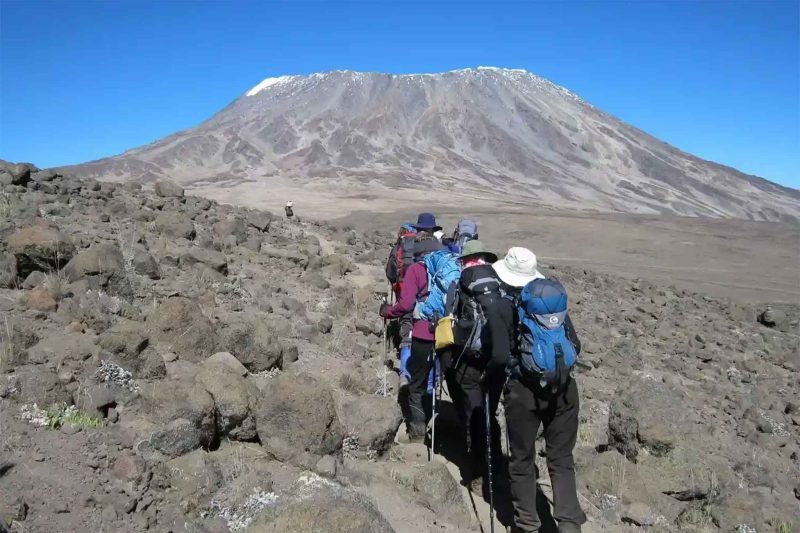
8-Day Shira Route Kilimanjaro Hike
Climbing Mount Kilimanjaro via the scenic Shira Route on an 8-day itinerary offers a remote rainforest start, exceptional acclimatization, and breathtaking panoramic views. Crossing the full Shira Plateau, this route is ideal for trekkers seeking fewer crowds, dramatic landscapes, and a longer, more gradual ascent profile for better summit success.
With The Woven Experience, your Kilimanjaro climb is expertly guided, safety-focused, and designed to deliver a truly immersive and rewarding journey to the Roof of Africa.
A Short Expert Guide to the Shira Route
Our Shira itinerary uses the Lemosho start and spends two nights on the Shira Plateau, giving one of the best acclimatization profiles on the mountain.
Route Highlights:
Rainforest start at Lemosho Gate
Expansive views across the plateau and surrounding landscapes
Acclimatization at Lava Tower
Iconic Barranco Wall climb
Summit approach via Stella Point
Difficulty Level: Moderate to Challenging
Success Rate: High (with the 8-day acclimatization profile)
Looking for a scenic, less crowded Kilimanjaro route? Book your 8-day Shira trek today.
Expert Recommendations
Our guides recommend the Shira Route for trekkers who want a quieter trail with strong acclimatization benefits.
Top Expert Tips:
Use the easy plateau day (Day 3) to rest and acclimatize
Take the first days slowly to adapt properly
Stay consistent with hydration and nutrition
Be prepared for cold nights from Shira 1 onwards
Not sure if Shira is right for you? Speak with our Kilimanjaro experts for personalized guidance.
How to Prepare for the Shira Route
Preparation is essential for a successful climb.
Physical Training
Cardio workouts (hiking, running, cycling)
Endurance hikes with elevation gain
Strength training for legs and stamina
Gear Essentials
Warm layered clothing (essential from Day 2)
Waterproof hiking boots
Insulated summit gear
Mental Preparation
Be ready for a long summit night
Stay patient and focused
Embrace gradual acclimatization
Best Time to Climb the Shira Route
You can climb Kilimanjaro all year, but the weather on the mountain changes a lot with both altitude and season. On this route, you start in warm rainforest and end in Arctic conditions on the summit, so you’ll pass through every climate zone in eight days.
What to expect at each altitude
- Rainforest (Days 1 and 8): Warm and humid, with a chance of afternoon showers and muddy trails.
- Shira Plateau and alpine desert (Days 2–6): Sunny and windy by day, with cold nights that can drop below freezing.
- Summit zone (Day 7): −10°C to −20°C (14°F to −4°F) before sunrise, with strong wind chill.
Month by month
| Months | Conditions | Crowds | Our verdict |
|---|---|---|---|
| January–February | Mostly dry and clear, with occasional summit snow | Moderate | ⭐ Excellent |
| March | Warmer, with rain becoming more likely | Low | Good shoulder month |
| April–May | Long rains: muddy rainforest, low visibility, snow higher up | Very low | Not recommended |
| June–October | Dry season, with clear skies and the best trail conditions | Highest in July–September | ⭐ Best overall |
| November | Short rains, mostly afternoon showers | Low | Good shoulder month |
| December | Rain easing, but busy over the holidays | High in late December | Good |
Our recommendation
For the best overall conditions, climb between June and October or in January and February. If you prefer quieter trails and don’t mind a chance of rain, March and November are good shoulder months. We don’t recommend April and May, when heavy rain makes the rainforest sections muddy and the views are often hidden by cloud.
Whatever month you choose, bring warm layers for the cold nights from Shira 1 onwards, and a good rain jacket for the rainforest.
Why Hike with The Woven Experience?
Climbing Kilimanjaro is a once-in-a-lifetime journey—and choosing the right team makes all the difference.
What Sets Us Apart:
Experienced, certified local guides
High summit success rates
Personalized pacing and attention
Advanced safety equipment and monitoring
Ethical porter treatment and sustainable practices
Authentic storytelling and cultural immersion
Climb with confidence—start your Kilimanjaro journey with The Woven Experience today.
Private Hikes vs Group Climbs
Private Hikes (Solo or With Your Group)
Best for:
Couples, families, or friends
Travelers seeking flexibility and privacy
Advantages:
Customized itinerary and pace
Dedicated guide support
Greater comfort and exclusivity
Group Climbs (Join Other Travelers)
Best for:
Solo travelers
Budget-conscious adventurers
Social experiences
Advantages:
Shared costs
Group motivation
Opportunity to meet like-minded travelers
Start Your Shira Adventure Today
The 8-day Shira Route offers a scenic, less crowded, and well-acclimatized journey to the summit of Mount Kilimanjaro. With its dramatic landscapes and extended itinerary, it’s one of the most rewarding ways to reach Uhuru Peak.





There are no comments yet.